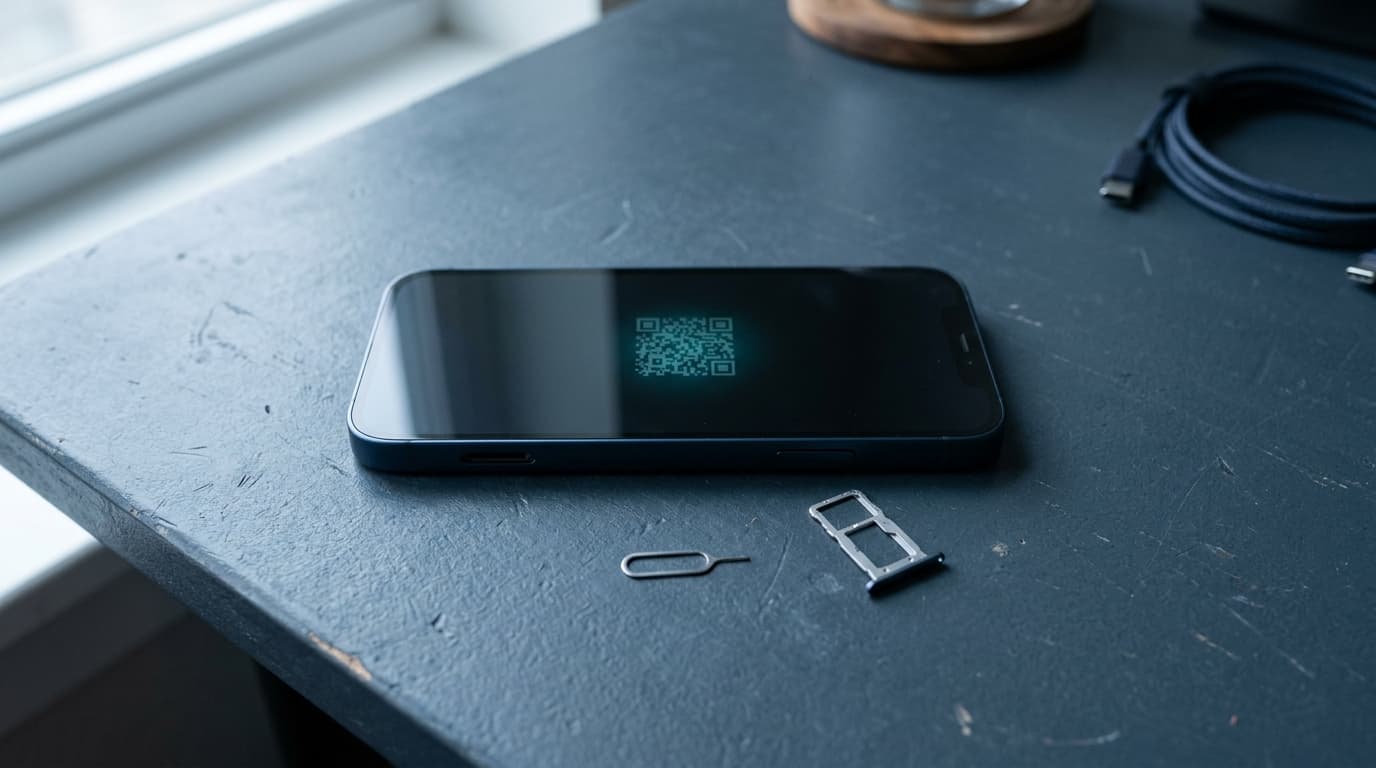
An eSIM is a SIM card built into the phone, activated with a QR code instead of a plastic chip. In Belgium it costs the same as a physical card and uses the same antennas. The real difference lies elsewhere: as of 19 October 2026, VOO and Mega do not offer it, while hey! does on the same network.
eSIM, SIM card, iSIM: seven terms, one network
Three formats coexist, and none of them touches the signal.
A physical SIM card is the chip you slide into the phone's tray, nowadays almost always in nano format. An eSIM is a chip soldered into the device, which the operator programmes remotely. An iSIM goes further and puts the SIM function inside the processor itself: chipmakers have the technology, but none of the fifteen Belgian brands checked mentions it in their offers.
In Belgium, only four companies own a mobile network (Proximus, Orange, Telenet and the newcomer DIGI). Every other brand either belongs to one of them or is an MVNO, a mobile virtual network operator renting capacity from a host network.
| Term | Definition | Figure or Belgian benchmark |
|---|---|---|
| SIM card (nano) | Removable chip, inserted in a tray | 12.3 × 8.8 mm, standard format since 2012 |
| eSIM | Soldered chip, profile loaded remotely by QR code | Built into about 80% of devices sold by Proximus (September 2025) |
| iSIM | SIM function built into the processor | No Belgian offer found as of 19/10/2026 |
| EID | Identity number of the eSIM chip | 32 digits, shown by dialling *#06# |
| Dual SIM | Two active lines in one phone | Nano + eSIM on iPhone since the XS (2018) |
| Quick Transfer | Moving a line from one phone to another without a QR code | Launched by Proximus on 12/09/2025, between devices on the same system |
| Network code | Identifier of the network actually used | 206 01 Proximus, 206 10 Orange, 206 12 DIGI, 206 20 Telenet |
The last term is the one that matters. A hey! eSIM and an Orange physical card both show 206 10: same antennas, same 5G, same indoor coverage.
eSIM or SIM card: which wins, criterion by criterion?
The eSIM wins on speed and security, the physical card on lending and troubleshooting. Price settles nothing.
| Criterion | eSIM | Physical SIM card | Advantage |
|---|---|---|---|
| Plan price | Identical | Identical | Draw |
| Activation time | A few minutes after ordering | 1 to 3 working days for delivery | eSIM |
| Coverage and speed | Same network, same code | Same network, same code | Draw |
| Changing phones | Transfer or new code, sometimes charged | Move the card, free | Card |
| Stolen phone | The chip cannot be removed | The card is pulled out in ten seconds | eSIM |
| Using your number on another device | Request to the operator | Slide the card elsewhere | Card |
| Brands available | 9 major brands out of 12 checked | All | Card |
| Phones without a tray (iPhone Air) | Only option | Impossible | eSIM |
| Smartwatch | Telenet only | Not applicable | Draw in practice |
The row that weighs most in 2026 is the second to last. Unveiled on 10 September 2025, the iPhone Air is sold without any SIM tray, the first phone on the Belgian market in that case according to Proximus. Picking a brand without eSIM today means accepting that a future phone may not take it.
On theft, the argument holds. A thief who removes a physical card cuts the line in ten seconds; an eSIM cannot be pulled out, and the phone stays reachable a little longer for tracking.
Which Belgian brands offer eSIM, and on which network?
Nine major labels out of twelve, but not evenly from one network to the next.
| Brand | Host network | eSIM | eSIM cost found | Entry plan, price excluding discounts |
|---|---|---|---|---|
| Proximus | Proximus | Yes, all plans | No fee published; shop visit if the QR code is deleted | 10 GB, €19.99 (21/09/2026) |
| Scarlet | Proximus | Yes, Red, Berry, Cherry and Hot | Free | 10 GB, €8 (09/10/2026) |
| Mobile Vikings | Proximus | Yes, all plans | No fee published | 10 GB, €10 (October 2026) |
| yoin | Proximus | Yes, at ordering | €5 to convert an existing card | 6 GB, €8.50 from month 13, after €6.50 for 12 months (27/09/2026) |
| Orange | Orange | Yes | Free | 12 GB, €15 from month 13 (29/09/2026) |
| hey! | Orange | Yes, at ordering | Free | 15 GB, €5, no discount (29/09/2026) |
| VOO | Orange | No | Physical card only | 15 GB, €18 (29/09/2026) |
| Mega | Orange | No | Physical card only | 5 GB, €8 (10/09/2026) |
| Telenet | Telenet | Yes, plus watches via One Number | Free, conversion included | 15 GB, €21 (Selectra, July 2026) |
| BASE | Telenet | Yes | No fee published | 15 GB, €15 excluding the 30% discount (27/09/2026) |
| DIGI | DIGI, 4G roaming on Proximus | Yes, at ordering | €1 per new installation code | 7 GB, €3, no discount (19/10/2026) |
| edpnet | DIGI | No | Physical card only | not checked |
eSIM status checked on official pages on 19 October 2026, except Mobile Vikings (CallMePower, October 2026), yoin (Selectra, 7 February 2025), VOO (CallMePower, 2026), and Mega and edpnet (our own check of 10 September 2026). Outside the table, Astel, a Belgian telecom comparison site, listed UNDO (Orange network) among brands with eSIM in October 2025, Neibo (Orange network) among those without, and Lycamobile (Telenet network) as compatible with only some phones.
Two corrections along the way. Scarlet now offers eSIM free of charge on its four plans, whereas Astel's October 2025 guide still listed it among brands without eSIM. So does hey!: in February 2025 its forum replied that eSIM had "no support", and its dedicated page now presents it as "entirely free".
On the Orange network, eSIM separates hey! from VOO
It is the only network where card format opens a visible price gap.
Four labels sell an entry plan there. Two offer eSIM, Orange at €15 for 12 GB and hey! at €5 for 15 GB. Two do not: VOO, at €18 for 15 GB, and Mega, at €8 for 5 GB. All of them use the same antennas and show the same 206 10 code. For the same 15 GB, hey! therefore costs €13 a month less than VOO, or €156 a year, and throws in the card format VOO refuses.
The explanation lies in the platform, not the antennas. VOO has been moving its mobile customers to the Orange network in waves since October 2024, and my reading is that a brand in the middle of a migration does not open a new card format halfway through; VOO has never explained it publicly. Mega, an MVNO backed by an energy supplier, only gets from its host the features its wholesale contract opens.
An iPhone Air buyer who is a VOO or Mega customer has two options: change label, or change phone.
How much does an eSIM cost when you change phones?
Usually nothing. But the exceptions are specific.
DIGI charges €1 for each new installation code: its eSIM cannot move from one device to another. yoin asks €5 to convert an existing physical card. At Proximus, a QR code works only once; after a reset, the new code is obtained in a shop or in the Proximus+ app, with itsme verification. Quick Transfer, at Proximus and Scarlet, moves the line in a few taps, but only between two Androids or two iPhones.
Switching from an iPhone to an Android therefore remains the eSIM's weak spot.

Dual SIM: two networks in one phone
The eSIM also works as a second slot. An iPhone since the XS accepts a nano card and an eSIM active at the same time; since the iPhone 13, two eSIMs can even run together. For an address poorly covered by one network, it is the cheapest workaround on the market: a main line at hey! on the Orange network, and a second DIGI line at €3 for 7 GB, on another network, which takes over when the first one weakens.
Before moving a line to eSIM, five points deserve two minutes:
- is the phone compatible? Dial *#06#: a 32-digit EID number confirms the eSIM chip;
- does the brand activate it at ordering, or do you first receive a physical card and convert it, as Astel found at BASE and Orange in 2025?
- is a phone change charged, and can it be done without a shop visit?
- is Wi-Fi available during activation, which yoin explicitly recommends?
- when porting your number to DIGI, the eSIM is first installed under a temporary number, and the transfer is then requested by phone.
Four cases where the physical card is still the right choice
You are with VOO, Mega or edpnet and do not plan to change label. You often switch between an Android phone and an iPhone. You regularly move your number to a backup device. Your phone simply has no eSIM chip.
In every other case, I would take the eSIM, without waiting for the next phone to make it mandatory.
We do not subscribe to any of these plans and measure nothing in the field: this page cross-checks the brands' official eSIM pages, consulted on 19 October 2026, with the site's own price checks and two dated comparison-site guides. Plans sorted by month-13 price, host network shown, are in our 5G plan ranking. To check your device against Belgian bands, see is my phone 5G compatible; for the network behind each label, the brand-by-network table; and to change brand while keeping your number and antennas, the seven-step guide. Number porting, eSIM included, is regulated by the IBPT (BIPT), Belgium's telecom regulator.
Sources: Proximus, eSIM page checked 19 October 2026 and press release of 12 September 2025 on Quick Transfer; Scarlet, eSIM page checked 19 October 2026; hey! Telecom, eSIM page checked 19 October 2026, and community forum thread of 18 February 2025; Orange Belgium, eSIM page and blog post of 8 July 2026; Telenet, eSIM and One Number pages checked 19 October 2026; DIGI Belgium, mobile FAQ checked 19 October 2026; Selectra, "yoin lanceert 5G en eSIM", 7 February 2025; CallMePower, Mobile Vikings and VOO mobile pages, 2026; Astel, "Quel opérateur pour un abonnement eSIM en Belgique ?", 31 October 2025; Test Achats, "Scarlet Mobile augmente les données mobiles, pas les prix", 9 October 2026; Wikipedia, "eSIM" article; the site's own checks of 10, 21, 27 and 29 September 2026. Official brand pages cited: hey! eSIM and Proximus eSIM. No link on this page is monetised.
Forfaits & data comparator
Compare all forfaits & data side by side.
Compare now →
Frequently asked questions
Bastien a passé sept ans dans le déploiement de sites mobiles en Wallonie et à Bruxelles avant de basculer côté rédaction, en 2021. Il connaît la différence entre une antenne 5G qui apparaît sur une carte marketing et une antenne qui porte réellement à travers un mur de brique. Depuis, il relève chaque mois les grilles tarifaires de Proximus, Orange, Telenet, BASE, DIGI, Mobile Vikings, Mega, hey! ou yoin, recoupe les débits avec les mesures de l'IBPT, et recalcule le prix sur 24 mois quand un opérateur affiche un tarif à 1 € la première année. Son constat : en Belgique, la 5G n'appartient qu'à trois réseaux, et la quasi-totalité de l'écart de prix entre deux abonnements identiques vient de la marque posée dessus, pas du signal. Il y a un truc qui le gêne dans les comparatifs qui classent Proximus premier sans jamais écrire qu'un forfait équivalent coûte trois fois moins ailleurs sur le même réseau.