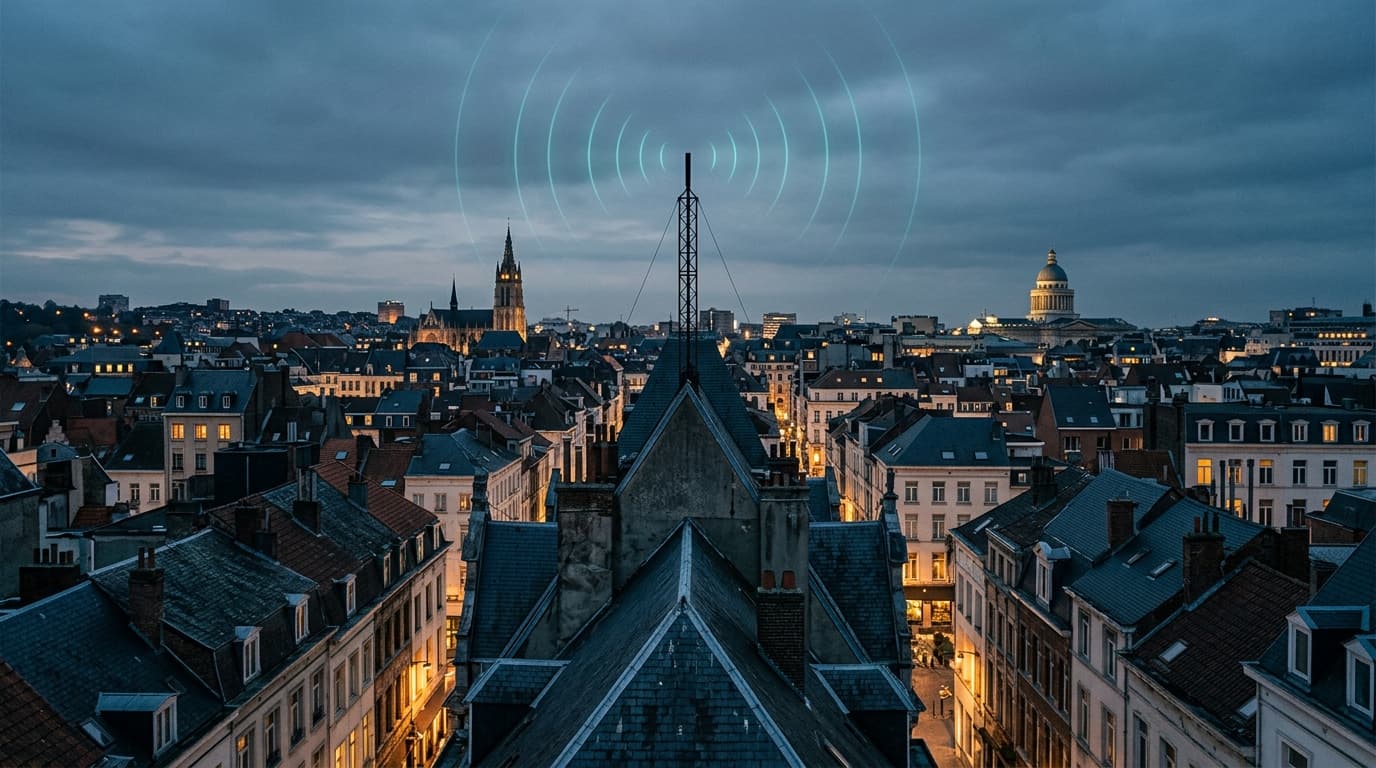
Brussels fell behind because its emission limit, the strictest in Belgium, technically ruled out 5G until 2023. The first antennas were switched on in September 2023, three and a half years after those in the port of Antwerp or in Leuven. Today the outdoor map has caught up, except on the Telenet/BASE network, and the available power is still rationed.
Why did 5G reach Brussels so late?
Because of regional law, not technology or money. In Belgium, spectrum is a federal matter handled by the BIPT (the Belgian telecoms regulator, IBPT in French), but exposure limits for radio waves belong to the three Regions. Brussels adopted a very strict ordinance in 2007, later raised to 6 V/m at the 900 MHz reference frequency. With such a limit, there was no room to add a 5G layer on sites already carrying 2G, 3G and 4G.
The block was visible from the first trial. Orange had picked Brussels as the first Belgian city to test 5G; the pilot was halted in 2019 by the environment minister of the time, Céline Fremault. On 1 April 2020, Proximus switched on 5G over its existing frequencies in some thirty municipalities, from Kortrijk to Hasselt by way of Zaventem and Overijse. Not a single Brussels municipality made the list: "not possible", its spokesperson said, because of the emission rules. Telenet started its own rollout in December 2021, in Flanders.
| Date | Step | What it meant for Brussels 5G |
|---|---|---|
| 2019 | Orange's Brussels pilot halted | No 5G antenna in the Region |
| 1 April 2020 | Proximus launches 5G over existing frequencies in some thirty municipalities | No Brussels municipality, no compatible limit |
| 23 July 2021 | Brussels government approves the principle of a 14.5 V/m limit | Announcement, no immediate effect |
| 21 June 2022 | BIPT multiband auction: 700 MHz and 3.6 GHz awarded | Licences valid everywhere, unusable in Brussels |
| Summer 2022 | Operators prepare to open 3.6 GHz after the summer | Brussels is the only Region without a finished legal framework |
| 17 February 2023 | Ordinance voted: 14.5 V/m outdoors, 9.19 V/m indoors | Legal framework in place, decrees still needed |
| End of June 2023 | Implementing decrees published in the Belgian Official Gazette | Operators file their permit applications |
| 31 August 2023 | First final permits (King Baudouin Stadium, Koekelberg, Berchem-Sainte-Agathe) | First 5G antennas in September |
| 2024-2025 | Orange plans most of its Brussels rollout for 2024, the last sites for 2025 | Outdoor coverage caught up by 2026 |
The liberal MR party, which had been calling for a revision since 2013, put the wait at "9 years, 1 month and 15 days" in January 2023. For the city that hosts the EU institutions, the line stuck.
Is Brussels still behind in 2026?
On the outdoor map, no. On one network, yes.
| 5G network | Brussels-Capital, outdoor, inhabited territory | Belgium, outdoor, territory | Reading |
|---|---|---|---|
| Proximus | 100.0% | 99.53% | Brussels on a par with the country |
| Orange | 99.9% | 99.22% | Brussels on a par with the country |
| Telenet/BASE | 94.3% | 99.98% | First nationwide, last in Brussels |
Brussels: BIPT coverage data aggregated by Selectra, page of 12 August 2026. Belgium: BIPT mobile atlas, January 2026 data, as reported by CallMePower on 16 September 2026. The two bases differ (inhabited territory versus total territory): the 5.7-point gap between Proximus and Telenet/BASE in Brussels is meaningful, a decimal-level comparison across columns is not.
That is the figure I keep from the whole file. Telenet/BASE started its 5G in December 2021 in Flanders, its home turf, and is now the best-covered network in the country; in Brussels, where every network had to wait for 2023, it still lags. And that network does not carry only BASE and Telenet. Lycamobile and TADAAM are MVNOs (brands renting someone else's network) on the same antennas: a Brussels resident with any of those four brands inherits the same gap.
DIGI, the fourth network, is not yet in the BIPT atlas. Selectra describes, as of 13 October 2026, its own network rolled out first in dense urban areas, with roaming on Proximus elsewhere, and no official list of covered Brussels neighbourhoods.
14.5 V/m for all transmitters combined
This is the core of the delay that remains.
The Brussels limit is not a cap per antenna, nor even per operator: it is a cumulative ceiling that adds up every transmitter reaching a publicly accessible place, including radio and TV antennas, which were not counted before. Three operators, radio and TV therefore share a single electric-field budget, and La Libre estimated in 2022 that this works out at roughly 8.4 V/m per operator in practice. For scale, the European recommendation sets 41.2 V/m at 900 MHz, and the industry federation Agoria was still asking Brussels in February 2023 to move closer to it.
Permit conditions point the same way. According to Brussels Environment, the authorised 5G antennas are dynamic antennas that steer their beam towards demand, and operators must install power-control software that automatically limits emission when demand is too high. Every new installation is simulated against all surrounding buildings and antennas, and the administration checks the settings of the Region's roughly 15,000 transmitters twice a month.
- The limit applies to all sources in a given place, not to a single antenna.
- The indoor limit (9.19 V/m) is lower than the outdoor one (14.5 V/m).
- Every antenna needs an environmental permit, which can be appealed.
- Power-control software throttles emission at demand peaks.
- Residents can ask Brussels Environment for a free measurement at home.
The serious objection fits in one sentence: the map says 100%. It is right, and it contradicts nothing. The atlas measures whether a usable 5G signal reaches you outdoors; it does not separate the 3.6 GHz band, which carries the speed, from the 700 MHz band, which travels far but offers ten times less spectrum. A power ceiling weighs first on 3.6 GHz, which struggles through walls and needs margin to reach indoors. I found no public speed measurement specific to the Brussels Region: the BIPT publishes its quality campaigns by road and rail line, not by Region. The link between the limit and speed is therefore an established mechanism, not a measured figure, and I present it as such.
Every new antenna goes through a permit that can be challenged
The 2023 delay will not replay wholesale. It can replay antenna by antenna.
A 2024 example: a permit granted to Proximus for twelve antennas on the drève des Bonniers, in Watermael-Boitsfort, deep in the Sonian Forest, was overturned in April by the Environment Board on appeal from an association and a resident. The reason: the regional land-use plan restricts equipment in forest zones. The BEAMS system has cut average processing time by three quarters; the right of appeal, however, remains open on every file.

Which network and which brand if you live in Brussels?
Network first, label second. In Brussels, Proximus and Orange start with an outdoor coverage lead over Telenet/BASE; once the network is chosen, the cheapest brand uses exactly the same antennas.
| Brand | Host network | Data | Monthly price after promotion | 5G | Checked |
|---|---|---|---|---|---|
| hey! mobile S | Orange | 15 GB | €5 | Included | 29/09/2026 |
| Orange Mobile Small | Orange | 12 GB | €15 | Included | 29/09/2026 |
| Mobile Vikings 40 GB | Proximus | 40 GB | €15 | Included from 40 GB | 27/09/2026 |
| Proximus Mobile Unlimited | Proximus | Unlimited | €49.99 | Included, only standalone 5G plan | 27/09/2026 |
| BASE 15 | Telenet | 15 GB | €15 | Included | 13/10/2026 |
| DIGI 60 GB | DIGI (Proximus roaming outside its own network) | 60 GB | €9 | On its own network | October 2026 |
Thirteenth-month prices, without temporary discounts, taken from brand pages and from Selectra on the dates shown.
On Orange's antennas, the hey! label costs €120 a year less than Orange Mobile Small for 3 GB more. For a Brussels resident it is the cleanest trade-off in the table: one of the two best-placed networks in the Region, at the lowest price recorded. I would not pay €49.99 at Proximus for standalone 5G hoping to get round the Brussels ceiling: the limit applies to every antenna, whatever core network sits behind it.
Three free checks before signing in Brussels
None of them requires a subscription.
Open the BIPT mobile atlas in "By area" mode with your postcode (1000 to 1210), then in detailed mode on your street, network by network and at indoor signal level. Next, look up antennas and permits on the Brussels Environment Geodata portal, which shows exposure simulations by address. Finally, use Belgian law: a telecom contract can be cancelled free of charge after six months, which makes the first half-year the only real test of reception at home. The full method is in our guide to testing coverage at your address, and the wall of your living room, which blocks 3.6 GHz regardless of the limit, is covered in why 5G stops at your front door.
We do not measure anything in the field and do not subscribe to any of these plans: this page cross-checks regional texts and press releases, BIPT data and dated price sheets. Which network each brand uses is in the brand-by-network table, and plans ranked on their thirteenth-month price, host network shown, are in our 5G plan ranking.
Sources: BX1, "5G : feu vert à une norme d'émissions de 14,5 V/m en Région bruxelloise", 23 July 2021, and "Fumée blanche pour la 5G à Bruxelles", 25 January 2023; La Libre, "Le déploiement de la 5G est désormais définitivement autorisé à Bruxelles", 17 February 2023; La Libre, "5G en Wallonie, un blocage devenu avant tout politique ?", 28 March 2022; BeMobile, 12 July 2022 and 31 July 2023; The Brussels Times, 15 July 2023; Brussels Environment, "La 5G arrive à Bruxelles sous escorte", 31 August 2023; RTBF, refusal of the drève des Bonniers permit, 10 April 2024; BIPT mobile atlas, January 2026 data; Selectra, 5G coverage by province and operator, 12 August 2026, and DIGI page, 13 October 2026; CallMePower, Belgian mobile network ranking, 16 September 2026; price sheets of hey!, Orange, Mobile Vikings, Proximus, BASE and DIGI checked between 27 September and 13 October 2026; Wikipedia, "5G". No link on this page is monetised.
Couverture & réseau comparator
Compare all couverture & réseau side by side.
Compare now →
Frequently asked questions
Bastien a passé sept ans dans le déploiement de sites mobiles en Wallonie et à Bruxelles avant de basculer côté rédaction, en 2021. Il connaît la différence entre une antenne 5G qui apparaît sur une carte marketing et une antenne qui porte réellement à travers un mur de brique. Depuis, il relève chaque mois les grilles tarifaires de Proximus, Orange, Telenet, BASE, DIGI, Mobile Vikings, Mega, hey! ou yoin, recoupe les débits avec les mesures de l'IBPT, et recalcule le prix sur 24 mois quand un opérateur affiche un tarif à 1 € la première année. Son constat : en Belgique, la 5G n'appartient qu'à trois réseaux, et la quasi-totalité de l'écart de prix entre deux abonnements identiques vient de la marque posée dessus, pas du signal. Il y a un truc qui le gêne dans les comparatifs qui classent Proximus premier sans jamais écrire qu'un forfait équivalent coûte trois fois moins ailleurs sur le même réseau.