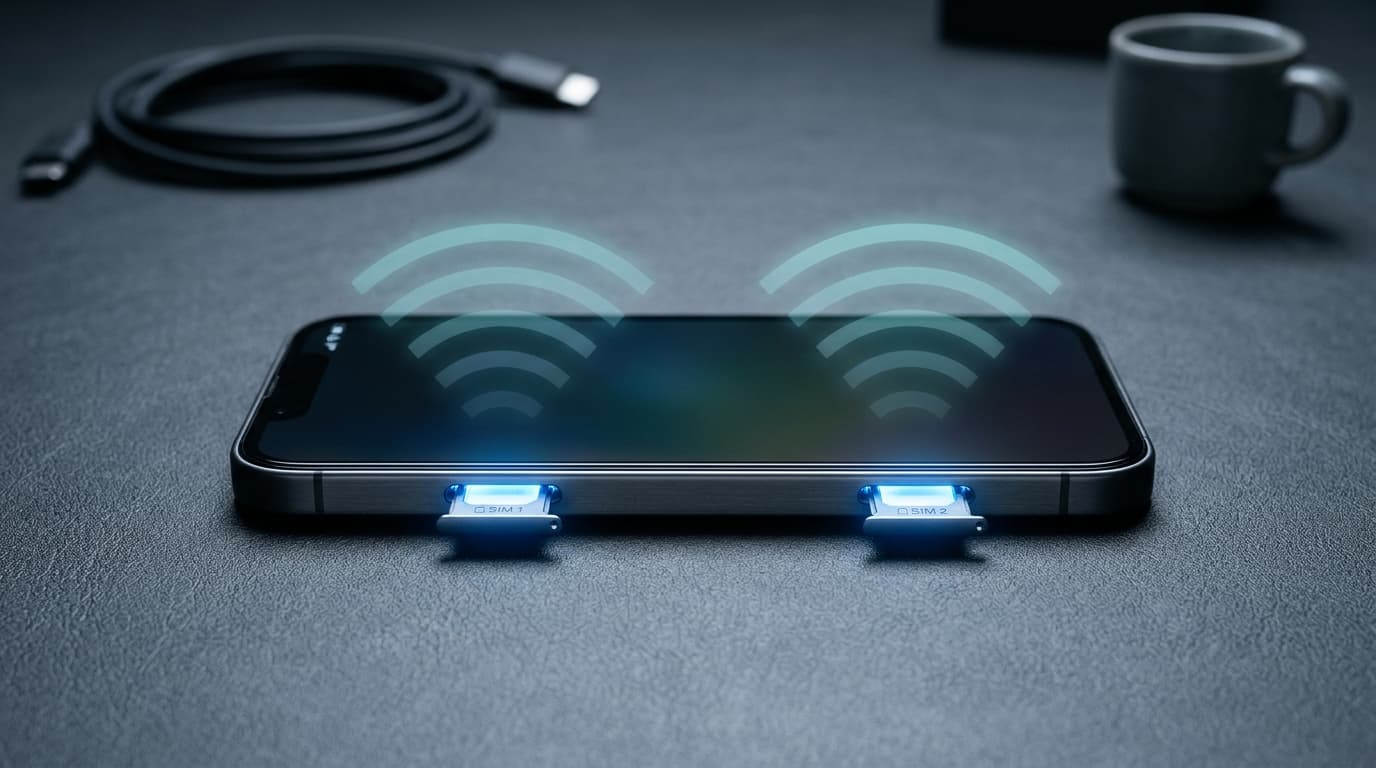
A dual SIM phone runs two lines at once, but it only protects you from poor coverage if the second card uses a different network. In Belgium that is far from automatic: Scarlet and Mobile Vikings, BASE and Lycamobile, or hey! and Mega all use exactly the same antennas.
Dual SIM: two numbers, one data line
The principle fits in one line.
A dual SIM phone runs two plans at once, as physical cards or eSIM: on iPhone since the XS, with two active eSIMs since the iPhone 13 according to Apple's support page, and on most Samsung Galaxy phones sold in Europe. Both numbers ring, each on its own network. Data, however, only goes through one line at a time, unless you turn on automatic switching, offered by both Apple and Samsung.
Remember this above all. The second line is only a backup if it picks up a signal where the first one gets nothing.
Why don't two brands make two networks?
Because in Belgium about fifteen brands share four networks. Most of them are MVNOs (mobile virtual network operators): they own no antennas and rent capacity from Proximus, Orange, Telenet or DIGI. Many second cards sold as a "backup" rent the same antennas as the first.
You can check it with the network code your phone shows in its settings: 206 01 for Proximus, 206 10 for Orange, 206 20 for Telenet, 206 12 for DIGI. Two cards showing the same code go down together. The table below matches the most common pairs with their actual host network, checked on 5 November 2026 against the network agreements published by operators and comparison sites.
| Main card (host network) | Second card (host network) | Antennas used | Real backup | Extra cost per month |
|---|---|---|---|---|
| Scarlet (Proximus) | Mobile Vikings (Proximus) | Proximus only | None | €10 |
| Scarlet (Proximus) | DIGI 7 GB (DIGI, Proximus roaming) | Proximus, DIGI in places | Weak | €3 |
| Mobile Vikings (Proximus) | Lycamobile 15 GB (Telenet) | Proximus and Telenet | Yes | €4.99 |
| BASE (Telenet) | Lycamobile 15 GB (Telenet) | Telenet only | None | €4.99 |
| BASE (Telenet) | hey! M 25 GB (Orange) | Telenet and Orange | Yes | €9 |
| hey! (Orange) | Mega 5 GB (Orange) | Orange only | None | €8 |
| hey! (Orange) | DIGI 7 GB (DIGI, Proximus roaming) | Orange, DIGI and Proximus | Yes | €3 |
| Orange (Orange) | Scarlet Red 10 GB (Proximus) | Orange and Proximus | Yes, on 4G | €8 |
Month-13 prices, no promotion running. hey! M €9 (Orange network, Selectra, price list checked in October 2026), DIGI 7 GB €3 (Selectra, November 2026), Lycamobile 15 GB €4.99 (Telenet network, CallMePower, consulted on 5 November 2026; the page mentions a 12-month commitment inconsistently). Mobile Vikings 10 GB €10 (Proximus network, CallMePower, October 2026), Scarlet Red €8 (Proximus network, Test Achats, 9 October 2026), Mega 5 GB €8 (Orange network, official site, 29 October 2026).
Three pairs out of eight back up nothing. Yet they are the most natural ones, because people often take their second card from a sister brand of the first, cheaper and already familiar. The list of networks by brand avoids that trap in thirty seconds.

DIGI, the false second network for Proximus customers
This is the most misleading case in the table.
DIGI presents itself as Belgium's fourth operator, with its own network built with Citymesh, and sells its entry card at €3 for 7 GB, eSIM and EU roaming included. The statement from BIPT, the Belgian telecom regulator, dated 7 May 2026 tells a different story about its real footprint: in the compliance test, DIGI's own network covers 34.4% of the population, against a 30% obligation, and the operator does not even appear in the coverage atlas, because it "mainly uses another operator's 4G network". That other operator is Proximus, with which DIGI signed five years of access to the national network in August 2023. La Dernière Heure still reported in February 2026 that DIGI rents most of its mobile network from Proximus and aims to cover the whole country with its own antennas within five years. As a result, for a Scarlet, Mobile Vikings, yoin or Proximus subscriber, a DIGI card usually picks up the same antennas as the main card, and on 4G at that.
For a hey!, Orange, BASE or Telenet subscriber, it is the opposite: the same €3 card opens two extra networks, DIGI's in cities already equipped and Proximus's everywhere else. It is the cheapest backup on the Belgian market, with one pricing catch: on the €3 plan, calls are only unlimited to DIGI numbers, and charged €0.01 a minute to other networks.
All three networks cover 90% of living rooms: is a second SIM still useful?
The objection is serious, and the figures support it.
According to BIPT's mobile network review of 7 May 2026, based on January 2026 data, very good indoor 5G coverage reaches about 92% of households at Orange, slightly less at Proximus and 90% at Telenet, up from 18% at the end of 2023. Outdoors, Proximus and Telenet come close to 100% of households, Orange is at 99.9%. Compliance tests give 99.9% population coverage for Proximus, 99.7% for Orange and for Telenet.
| BIPT indicator (7 May 2026) | Proximus | Orange | Telenet | DIGI |
|---|---|---|---|---|
| Very good indoor 5G, households | slightly under 92% | about 92% | 90% | not measured |
| Outdoor 5G, households | close to 100% | 99.9% | close to 100% | not measured |
| Population coverage, compliance test | 99.9% | 99.7% | 99.7% | 34.4% (own network) |
| Coverage along railway lines | 99.5% | 99.2% | 99.8% | not measured |
From a distance, no network leaves more than one household in ten without good indoor 5G, and the second card looks like wearing a belt with braces. Seen from your address, the average says nothing, because the 8 to 10% of poorly served households are not the same from one network to the next: a house at the bottom of a valley can sit in Telenet's gap and be fully covered by Orange, and BIPT's atlas shows it street by street. Add the cases averages ignore, such as a saturated festival or stadium, where Selectra advised in July 2026 to bring a second card on a different physical network, and the railway lines where BIPT notes weaker stability, Liège-Welkenraedt and Namur-Arlon first among them.
My reading is this: for most Belgian subscribers, a second card changes nothing day to day; for those a coverage map places in the bad tenth of a network, it changes everything, and it costs less than switching brand.
Wi-Fi calling fixes indoors, not the road
Before buying a second card for a poorly covered living room, there is a free fix. Wi-Fi calling (VoWiFi) routes your calls through your home internet connection, on your usual number, and the site's records show it active at Proximus, Scarlet, Mobile Vikings, yoin, Orange, hey!, Telenet and BASE, according to our VoLTE and Wi-Fi calling table brand by brand. DIGI does not advertise it, and VOO is finishing its migration.
It is useless outdoors. In the car, on a hike, on a station platform or in a second home without a router, only a second line on another network takes over. The guide to 5G that stops at your front door covers the other indoor option, and points out that installing a non-approved signal booster is illegal in Belgium.
A few cases where a second card is pointless:
- your problem is limited to the house and you have a fixed connection: turn on Wi-Fi calling;
- your second card shows the same network code as the first;
- your phone only takes one card and has no eSIM, which the code *#06# checks (a 32-digit EID number signals an eSIM chip);
- you expect to receive calls to your main number while its network is down: the second line has its own number, and only call forwarding when unreachable, whose cost depends on the brand, bridges the gap.

How much does a real second network cost, depending on your main card?
Less than the gap between two brands on the same network. That figure turns the usual reasoning upside down.
On the Orange network, Orange Mobile Small has cost €15 a month for 12 GB since 18 January 2026, with no promotion. For €12, hey! M (25 GB, same Orange antennas) and a 7 GB DIGI card give 32 GB and three possible networks, Orange, DIGI and Proximus: €36 a year less than the Orange card alone. On the Proximus network, Mobile Easy costs €19.99 for 15 GB from month 13, after €15.99 for 12 months (proximus.be, 1 November 2026); Mobile Vikings 10 GB at €10, on the same Proximus antennas but without 5G on that tier, plus Lycamobile 15 GB at €4.99 on the Telenet network, come to €14.99 for two networks. On the Telenet network, BASE 15 (20 GB since late October 2026) costs €15, and €10.50 for life if you sign up before 16 November 2026; a €3 DIGI card adds DIGI and Proximus. For DIGI customers themselves, the logical backup is hey! M at €9, on Orange, or Lycamobile at €4.99, on Telenet, but not a brand on the Proximus network.
The second card needs neither 5G nor a big allowance. It needs different antennas, and that is the only criterion that justifies paying for it.
One note on hey!: comparison sites still list an S plan with 15 GB at €5, which Test Achats, the Belgian consumer association, reported as discontinued in May 2025. Check it is on the order page before relying on it.
We have not taken out any of these cards and measure nothing in the field: this page cross-checks published network agreements, dated price lists and BIPT measurements. Plans ranked on their month-13 price, host network shown, are in our 5G plan ranking. To find out which network works best at home before choosing your main card, see how to test coverage at your address. The coverage figures quoted come from BIPT's mobile network review of 7 May 2026 (in French), and switching brand while keeping your number is regulated by BIPT (in French).
Sources: BIPT, "Bilan des réseaux mobiles" press release, 7 May 2026 (January 2026 data); Apple, support page "Using Dual SIM with an eSIM", consulted on 5 November 2026; Citymesh, "DIGI ensures national roaming with Proximus", 25 August 2023; La Dernière Heure, DIGI network rollout, 26 February 2026; Selectra, DIGI and hey! Telecom pages, updated in November 2026, "Festivals 2026: le réflexe à deux euros", 7 July 2026, and "Double SIM: ligne pro et perso sur un seul GSM", 28 August 2026; CallMePower, Lycamobile (consulted on 5 November 2026) and Mobile Vikings (October 2026) pages; Test Achats, Scarlet, 9 October 2026, and hey!, 14 May 2025; Mega, official price list, 29 October 2026; Proximus, Mobile Easy page, 1 November 2026; the site's own records of 18 and 26 October 2026. None of the links on this page are monetised.
Couverture & réseau comparator
Compare all couverture & réseau side by side.
Compare now →
Frequently asked questions
Bastien a passé sept ans dans le déploiement de sites mobiles en Wallonie et à Bruxelles avant de basculer côté rédaction, en 2021. Il connaît la différence entre une antenne 5G qui apparaît sur une carte marketing et une antenne qui porte réellement à travers un mur de brique. Depuis, il relève chaque mois les grilles tarifaires de Proximus, Orange, Telenet, BASE, DIGI, Mobile Vikings, Mega, hey! ou yoin, recoupe les débits avec les mesures de l'IBPT, et recalcule le prix sur 24 mois quand un opérateur affiche un tarif à 1 € la première année. Son constat : en Belgique, la 5G n'appartient qu'à trois réseaux, et la quasi-totalité de l'écart de prix entre deux abonnements identiques vient de la marque posée dessus, pas du signal. Il y a un truc qui le gêne dans les comparatifs qui classent Proximus premier sans jamais écrire qu'un forfait équivalent coûte trois fois moins ailleurs sur le même réseau.